New Mexico’s warm temperatures, dry climate, and diverse landscapes support many spider species. While most spiders in New Mexico are not considered medically significant, they can still become unwelcome guests when they build webs around entryways or move into garages, storage areas, and living spaces.
Understanding which spiders are common, when they are most active, and what attracts them to homes can help homeowners recognize potential problems and take practical preventive steps.
New Mexico State University’s spider checklist includes more than 1,000 species recorded across the state. Homeowners are unlikely to encounter most of them, but several groups are commonly noticed around residential properties.
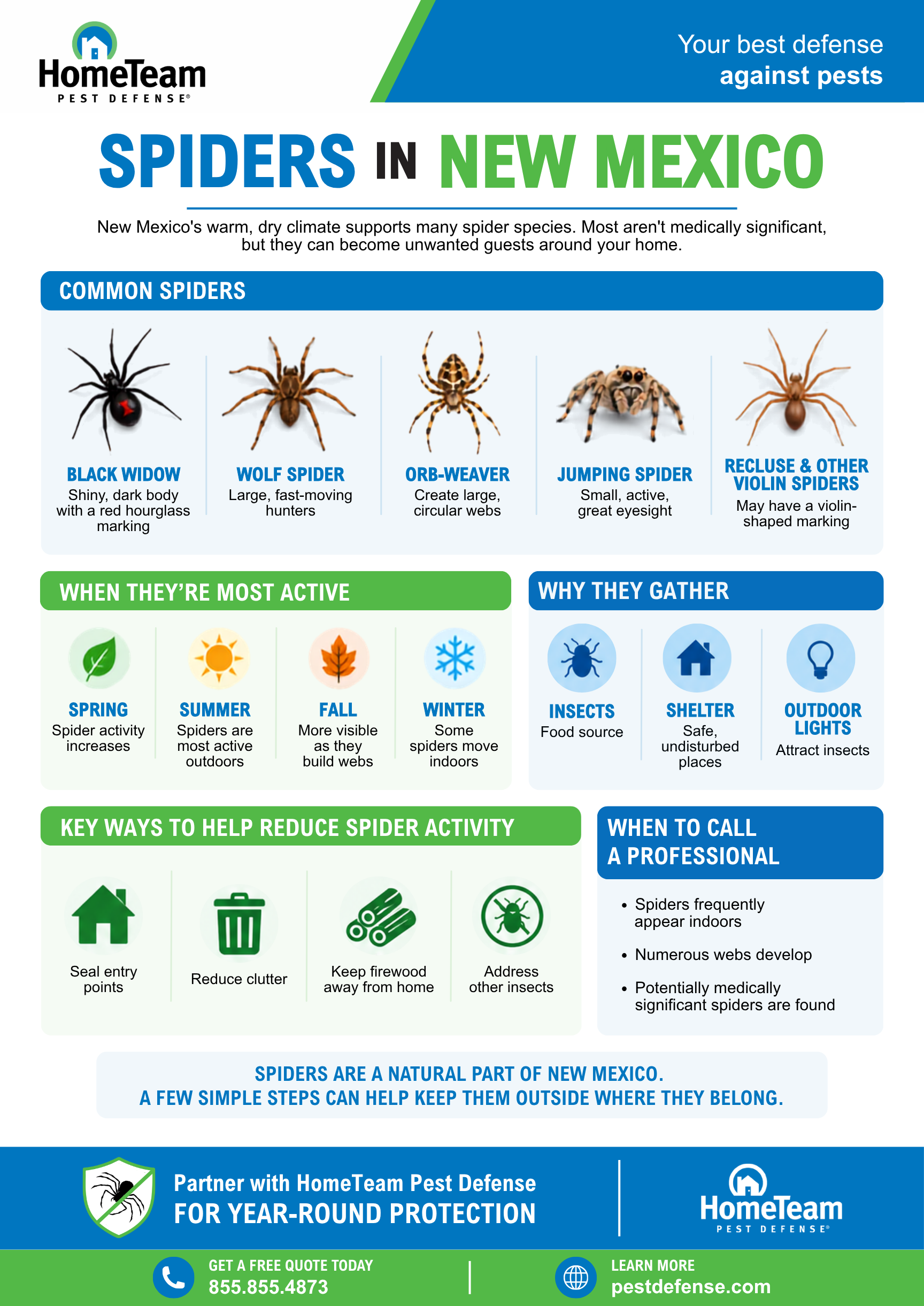
Black widows are among the most recognizable spiders in the region. Adult females typically have shiny, dark bodies and a red or orange hourglass-shaped marking underneath the abdomen.
They prefer quiet, protected locations such as:
Black widows generally avoid people, but they may bite when trapped, pressed against the skin, or disturbed near their webs.
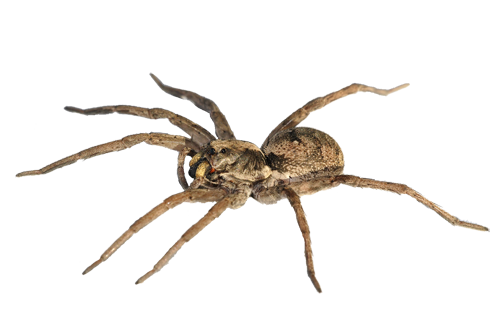
Wolf spiders are active hunters that do not rely on webs to capture prey. Their brown, gray, or tan coloring can help them blend into soil, landscaping, and flooring.
Homeowners may see wolf spiders moving quickly across patios, garages, or indoor rooms. Their larger size can be alarming, but they usually enter buildings while searching for insects, shelter, or more favorable temperatures.
Orb-weavers create the large, circular webs often seen between shrubs, fences, porch posts, and exterior lighting fixtures. They are especially noticeable in late summer and fall when both spiders and their webs have grown larger.
These spiders are generally beneficial outdoors because they feed on flies, moths, mosquitoes, and other insects.
Jumping spiders are compact, active spiders known for their quick movements and strong eyesight. Instead of constructing webs to catch prey, they stalk and jump onto insects.
They are often found near windows, walls, patios, and other sunny areas where insect activity is present.
Violin spiders are named for a violin-shaped marking that may appear on the upper body. However, markings alone are not a reliable way for homeowners to identify a spider. New Mexico State University recommends consulting a specialist when accurate identification is important.
Widow and violin spiders are considered among the more medically significant spider groups in the Southwest.
Spider activity can occur throughout the year, particularly inside climate-controlled buildings. Outdoor activity generally increases as temperatures warm and insect populations become more abundant.
Homeowners may notice different patterns by season:
Many hunting spiders are most active at night, while jumping spiders are commonly active during daylight hours.
Spiders usually remain where they can find insects, shelter, and undisturbed hiding places. Conditions that may encourage activity include exterior lights that attract insects, cluttered storage areas, open gaps around doors, damaged screens, and vegetation touching the structure.
Homeowners can help reduce spider activity by:
An occasional outdoor spider usually does not indicate a major problem. Professional service may be helpful when spiders repeatedly appear indoors, numerous webs develop around the property, or potentially medically significant spiders are found near frequently used spaces.
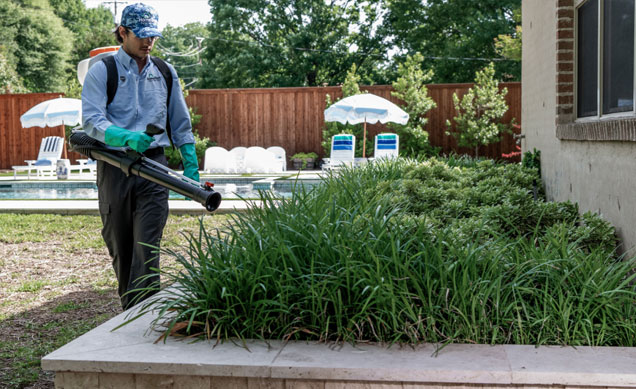
HomeTeam Pest Defense can inspect homes for pests, identify areas that may support spider activity, and recommend services that help reduce spiders and the insects they feed on.
Spiders are a natural part of New Mexico’s environment, but they do not need to become a constant presence inside or around your home. Routine maintenance, reduced clutter, sealed entry points, and attention to insect activity can make residential spaces less attractive to them.
For professional help addressing spiders and other household pests, contact HomeTeam Pest Defense to schedule service.
Would you like to call 844.372.7552?
×Would you like to call 844.372.7553?
×Would you like to call 844.372.7558?
×Would you like to call 520-900-5731?
×Would you like to call 844-574-1560?
×Would you like to call 844-372-7552?
× Find My Branch
 Call Now: (877) 461-7378